
Large teppanyaki grill tables can be moved upstairs. The answer to a table that will not fit in the lift is settled before the order is placed.
The sequence is: measure the doorway, the lift car and the stair turn along the delivery route, draw the layout from those measurements, then fix the split from the drawing. A standard table splits into an upper and a lower part. A long table with several heating zones is built as several units and jointed on site. The order of routes is fixed: the lift, then the stairs, then a hoist to the roof where the floor is too high.
Measure, then draw
What is measured is the clear opening, not the nominal size. The doorway gives clear width and height. The lift car gives inside width, depth, height and door width. The stair turn gives the clear width of the landing and the tread. If any of the three is taken loosely, the drawing that follows is wrong.
The layout drawing is issued by Zhiming, the teppanyaki grill table maker. It marks the table position, countertop size and the direction of air in and out, and the carrying route is walked on the drawing, so a doorway needing its leaf removed or a corridor needing to be cleared shows up on paper. The drawing serves the property office and the split at the same time: once position and orientation are fixed, the width of the route is known.
Upper and lower on a standard table, several units on a long one
A standard table, such as a rectangular classic teppanyaki grill table, is split into an upper and a lower part: the countertop with its griddle is one piece, the base cabinet and frame the other. Height and width come down on each piece, so they go into the car upright or at an angle, using the diagonal of the car instead of its floor area.
A custom table that is very long or irregular, such as an extra-large sectional teppanyaki grill table, is built as several units, one per heating zone, each with its own griddle, jointed to the drawing on site. The split is not invented for transport: the table is already organised by heating zone, one zone with one set of heating and control, and separate units hold temperature more steadily. Joints fall between zones and are levelled, ground and brushed on site, so the finished counter shows no seam.
Three ways up
Where there is a lift, use the lift. Confirm three things before loading: the doorway clears, the car takes the piece, and the load rating is enough. A doorway that clears while the car does not is the common miss when measuring.
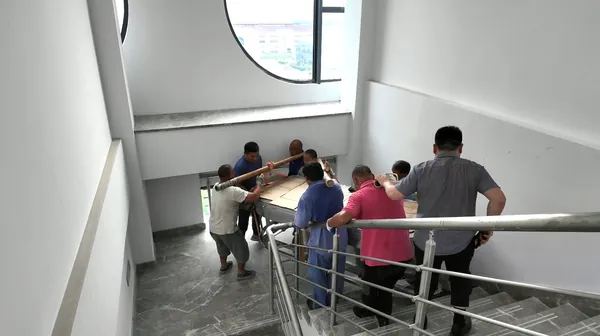
Where the lift will not take it, use the stairs. Sections are carried up by hand, and what is measured is the clear width of the turn landing and the tread.
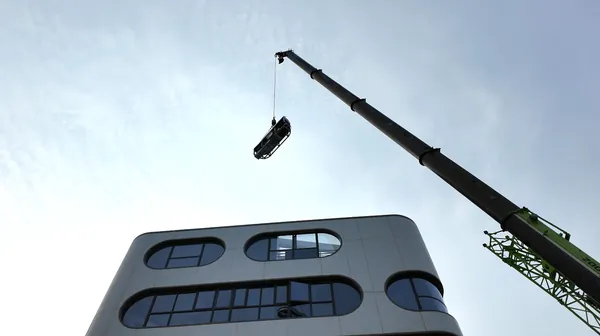
Where the floor is too high, or the table goes up to the roof, carrying is not practical and a hoist takes over: the table is lifted to the roof and brought down from above. Three things are confirmed with the property office in advance: whether the roof can be worked on, the lifting position and time window, and whether a road closure and insurance are needed. The window is set by the property office, usually two to four weeks ahead.
The order does not change
Measure, draw, then fix the split and the route. Done the other way round, the table is built before the route is solved, and what changes is the schedule and the cost. Whether a teppanyaki grill table reaches the floor is not a carrying problem; it is whether the route was measured before the order.
So the questions asked before an order go beyond countertop length, shape and functions: the three clear dimensions on the route, and the floor the table has to reach. With those settled, the layout drawing and the split go to the owner together.
About Cookeryaki
Cookeryaki, founded in 2004, makes teppanyaki grill tables, with headquarters and a showroom in Pudong, Shanghai, and a 5,000+ sqm factory in Huai'an, Jiangsu. Countertop size and shape are built to order, and every table carries a built-in fume purification system with a purification rate of up to 95%. Tables go into teppanyaki restaurants, buffets and chains, hotels, private clubs and food halls, and the company exports to Southeast Asia, the Middle East, Russia, Europe, North America and Latin America. It holds multiple international certifications and dozens of patents granted by the China National Intellectual Property Administration.