
The extraction duct on a teppanyaki grill table is sized by airflow and routed by the site. No single set of figures fits every job, but a few rules hold, and breaking them costs extraction inside the pipe.
Airflow sets the duct size
Model, counter length and inlet style each change the airflow required. An undersized duct raises resistance, adds noise and loses extraction. An oversized duct drops the air velocity, and oil fume settles and builds up on the walls. Once the route is fixed, the diameter is issued with the fan selection in the extraction plan. The contractor works to that drawing instead of guessing.
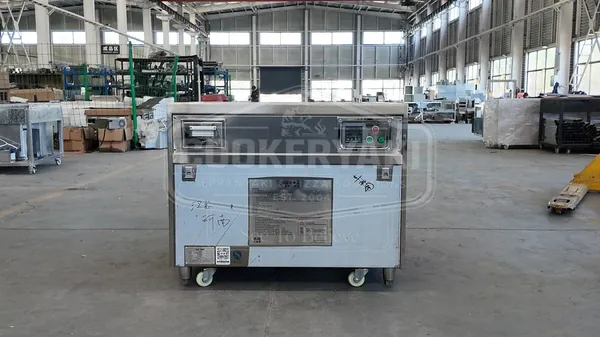
Short runs, few bends
Every 90° bend adds resistance equal to a length of straight duct. A route with three bends and a straight run behave very differently on the same fan. Set the outlet position before the table position. The common mistake is a long horizontal run followed by a climb at the end, which collects grease and is hard to clean.
Downdraft needs a single outlet duct
The fan and the purifier sit inside the body, so cleaned air leaves through one outlet to the outside or to the shaft. The outlet can be placed below the chef's position, at either side of the table, or straight down, whichever route is shorter. That single connection is why downdraft suits retrofit projects.
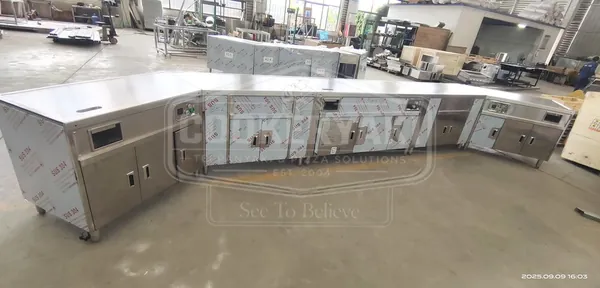
Overhead extraction needs a hood and a duct
A hood covers the griddle directly, catches the rising fume, and ducting carries it away. The duct follows the ceiling design, and bends are kept to a minimum. In an open kitchen teppanyaki setup, a hood overhead blocks the sightline, so it is avoided where possible.
Terminations
An outside termination needs a backdraft damper. A shaft connection needs confirmation that the shaft is shared and who else discharges into it. Flexible duct is for short transitions. On site, actual duct routes can be checked against the overhead units in our teppanyaki photos.
Three inputs before any calculation
Floor plan, ceiling height and shaft position. With those three, the route, duct size, bend count and fan selection are drawn in one pass.
Duct practice is local
Duct material, route and termination follow local code and the landlord's view. We issue the route drawing and connection sizes, and the contractor builds to local code.
Cookeryaki at a glance
In food halls, back-of-house kitchens and projects on a shared shaft, the duct is as good as the drawing. Route, diameter and connection sizes are issued from the floor plan, ceiling height and shaft position, and production follows. Beyond seven standard shapes, L, U, S and T forms and long joined runs are built to the drawing. An 8-metre unit arrives in four sections. The factory sits in Huai'an, Jiangsu, with 5,000+ sqm of production space, and headquarters are in Pudong, Shanghai.
About Cookeryaki
Cookeryaki, founded in 2004, makes teppanyaki grill tables, with headquarters and a showroom in Pudong, Shanghai, and a 5,000+ sqm factory in Huai'an, Jiangsu. Every table has a built-in fume purification system with a purification rate of up to 95%, and the countertop size and shape are built to order. The company holds multiple international certifications and dozens of patents granted by the China National Intellectual Property Administration.