
A teppanyaki grill table can carry more than the griddle. Induction hobs, fryers, steamers and hot pots are built into the same countertop, and the position of each one is set by the service line rather than by what is left over at the ends.
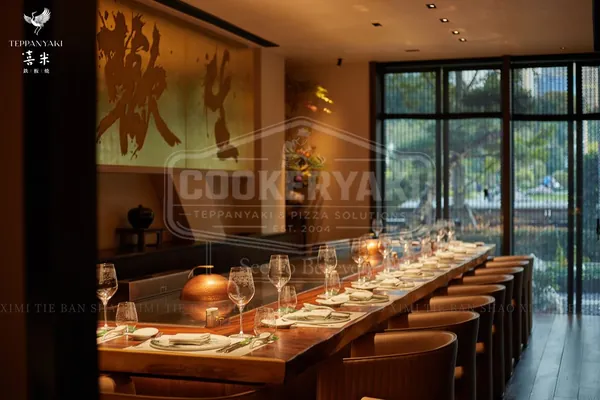
What sits where
Work moves in one direction on a teppanyaki counter: raw product in, cooked product out. Anything the chef reaches for in the middle of a service sits within arm reach of the plate, which usually means the induction hob or the hot pot. Units that need a water connection or a drain go to the outer end, where the pipework can reach them without crossing the griddle.
What an extra unit changes
Adding a unit is not a matter of cutting another hole. The total connected load goes up, which changes the supply cable and the breaker. The countertop loses a section of surface, so the frame underneath is checked again. And the extraction has to cover the new position: a fryer or a steamer releases a different mix of vapour from a griddle, and the inlet has to sit where that vapour rises.
Drawing before production
This is why a multi-function counter is drawn before it is built. The drawing fixes the position of each unit, the load of each one, and the route of the pipework and the duct. After that the supply voltage is calculated, from the configuration that will actually be installed rather than from a catalogue figure.
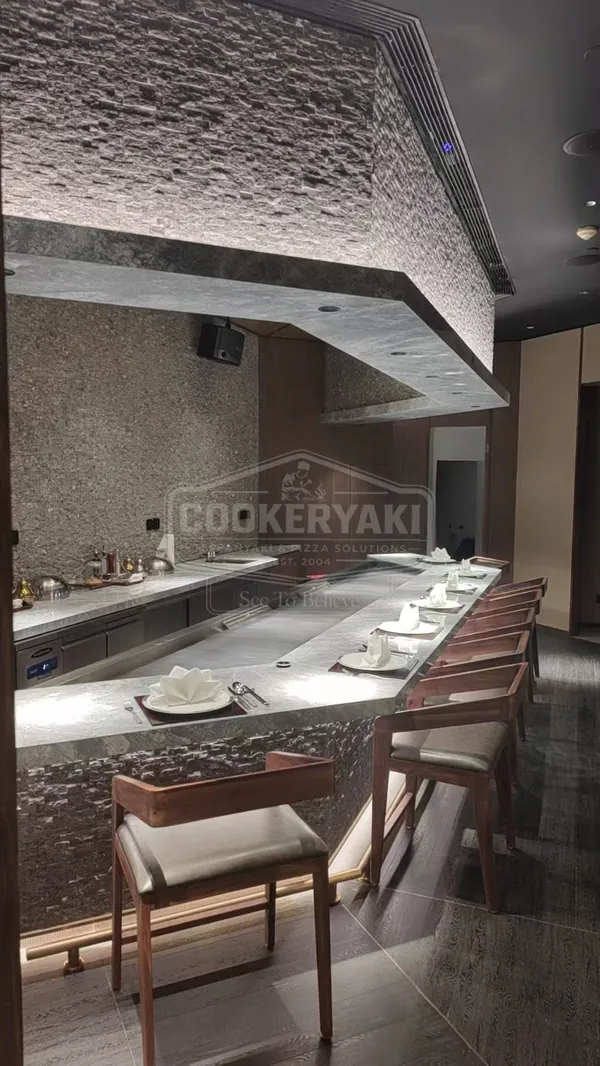
The combinations themselves are standard: a griddle with an induction hob, a griddle with a fryer, a counter carrying a steamer and a hot pot at the ends. Which combination suits a site depends on the menu, and the custom teppanyaki grill table with extra modules page shows how the modules are laid out. Load and supply questions are covered in the commercial teppanyaki FAQ.
About Cookeryaki
Cookeryaki, founded in 2004, makes teppanyaki grill tables, with headquarters and a showroom in Pudong, Shanghai, and a 5,000+ sqm factory in Huai'an, Jiangsu. Countertop size and shape are built to order, and a counter can carry several function modules in one run. Every table has a built-in fume purification system with a purification rate of up to 95%. Tables go into teppanyaki restaurants, hotels, private clubs and food halls, and the company exports to Southeast Asia, the Middle East, Russia, Europe, North America and Latin America. It holds multiple international certifications and dozens of patents granted by the China National Intellectual Property Administration.