
Yes, but three things have to line up: whether the equipment holds up, how fast the heat source recovers, and whether the number of tables and chefs matches the room. Heating speed is one part of it.
Reliability matters more than speed
When a table fails at peak, what is lost is not one service but the next few days. Guests do not come back, reviews drop, and the wait for a part is a trading day standing still.
Commercial reliability comes down to three things: whether the unit is built for continuous service, whether wear parts can be replaced on their own, and whether the manufacturer holds spares and answers a call. A heating element that can be swapped singly, a fan and a control board that are separate parts, and a response time agreed before the contract are worth more than any figure on a spec sheet.
Recovery speed, and why induction suits peak service
An induction plate heats the griddle by electromagnetic induction: the plate itself carries the heat, so when a course lands and the surface dips, the power brings it back quickly. Heating tubes warm the element and pass that heat into the plate through several layers, so the thermal lag is larger and both the rise and the recovery are slower.
For continuous service, a broad menu and consistent doneness, induction is the better fit. For a fixed counter menu on a steady rhythm, tubes are enough and hold temperature more evenly.
Capacity has to be calculated
How many covers a table can turn out in an hour depends on the menu and how much prep is done in advance. Industry experience: one table with a skilled chef and pre-portioned mise en place turns out forty to fifty covers an hour; add on-site preparation and that can halve.
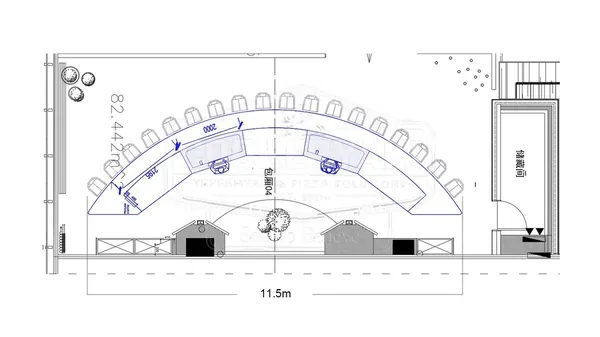
Once the per-table figure is known, compare it with the covers expected at peak and the average dwell time. The gap is what has to be covered by more tables or more hands. Counter length maps to seat count, but a longer counter does not plate faster.
Chefs and menu are the last gate
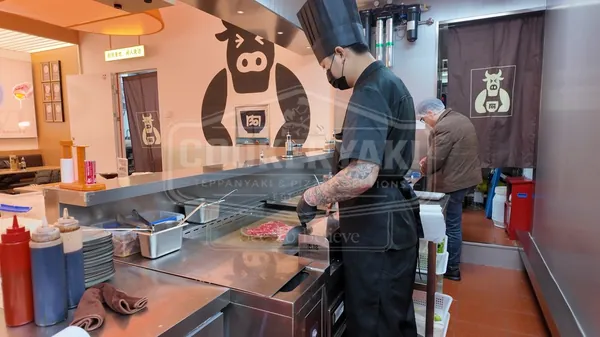
On a counter a little over a metre long, one chef can run three dishes at once across a hot zone, a medium zone and a cool zone. That works when the menu cooperates: keep dishes that plate within three minutes on site, leave the complex ones off, portion in advance, and when the room fills, split the work so one chef handles sides, one the quick sautes and one the slow-grilled mains, with mains and sides landing together.
The counter carries two zones
The centre is the heating zone, used for searing. The rim is the holding zone, warm but not separately controlled, where meat rests, finished plates wait, and slower items finish gently. A steak moved to the rim relaxes and the juices settle back through the meat, so less is lost when it is cut.
How to prove it
Run a real sequence at commissioning. Three courses in a row shows the drop and the recovery; extraction and power on together tests the breaker; and the chef walks the actual pass to see whether plating doubles back. Those three tell you more than a specification sheet. If the temperature drops hard on the trial run, the cause is usually zoning or extraction resistance, and changing the layout costs less than changing the equipment.
Seasoning, temperature control and daily care are covered in our teppanyaki maintenance guide, and finished installations are shown in our restaurant teppanyaki pages.
About Cookeryaki
A restaurant that queues at peak usually has a fitting problem, not a power problem: the heat source, the zoning and the hands have to match the rhythm. Cookeryaki matches the heat source to the service: induction where recovery speed matters, tubes where steadiness matters, the counter divided into heating zones by the number of chefs, and dimensions drawn to the room. Tables are built in a 5,000+ sqm factory in Huai'an, Jiangsu, and every unit is powered and tested before dispatch; the Pudong showroom lets buyers run their own menu.